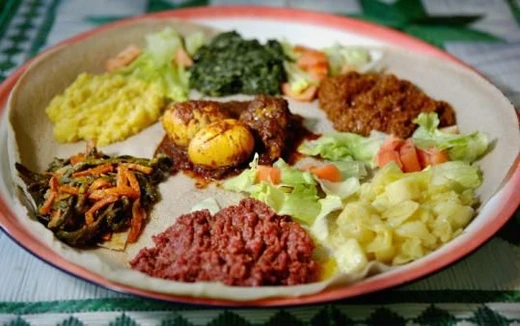
Aframomum corrorima
A spice plant native to East Africa, used in cuisine and medicine.

Wikipedia / Wikimedia Commons
Aframomum corrorima is a species of flowering plant in the ginger family, Zingiberaceae. It is an herbaceous perennial that produces leafy stems 1–2 meters tall from rhizomatous roots, with dark green leaves and pink flowers that give way to red, fleshy fruits containing shiny brown seeds. The spice obtained from its seeds, known as Ethiopian cardamom, false cardamom, or korarima, is extensively used in Ethiopian and Eritrean cuisine and herbal medicine.
- field
- Botany, spice plant
- known_for
- Ethiopian cardamom, korarima spice
- native_range
- Tanzania, western Ethiopia, southwestern Sudan, western Uganda
- cultivation
- Ethiopia and Eritrea
- seed_diameter
- 3–5 mm
- leaf_size
- 10–30 cm long, 2.5–6 cm across
Lore & Background
Aframomum corrorima is a perennial herb with leafy stems reaching 1–2 meters in height, growing from rhizomatous roots. Its leaves are alternately arranged, dark green, elliptical to oblong, and measure 10–30 cm long by 2.5–6 cm across. Pink flowers appear near the ground and develop into red, fleshy fruits containing shiny brown seeds typically 3–5 mm in diameter.
Reader's Guide
Aframomum corrorima is significant as the source of Ethiopian cardamom, a spice integral to Ethiopian and Eritrean cuisine. It is a key ingredient in spice mixtures such as berbere, mitmita, and awaze, and is also used to flavor coffee. Its flavor is comparable to that of green cardamom (Elettaria cardamomum). In Ethiopian herbal medicine, the seeds serve as a tonic, carminative, and laxative. The plant is native to Tanzania, western Ethiopia, southwestern Sudan, and western Uganda, and is cultivated in Ethiopia and Eritrea, though fruits are typically harvested from wild plants. Dried fruits are widely sold in markets and are relatively expensive, while fresh fruits are available in production areas. The essential oil composition varies: dried seeds and pods contain major components 1,8-cineole and (E)-nerolidol; fresh seeds feature 1,8-cineole, sabinene, and geraniol; fresh pods contain γ-terpinene, β-pinene, α-phellandrene, 1,8-cineole, and p-cymene.
Did You Know?
- The spice from Aframomum corrorima is known as Ethiopian cardamom, false cardamom, or korarima.
- Its seeds are used in Ethiopian herbal medicine as a tonic, carminative, and laxative.
- The plant is native to Tanzania, western Ethiopia, southwestern Sudan, and western Uganda.
- In fresh seeds, the major essential oil component is 1,8-cineole, followed by sabinene and geraniol.
Botanical Profile and Growth Habit
Aframomum corrorima is a member of the Zingiberaceae family, the same botanical group that includes ginger and true cardamom. As an herbaceous perennial, it regenerates year after year from underground rhizomatous roots, sending up leafy stems that reach between one and two meters in height. The foliage consists of dark green leaves arranged in an alternating pattern along the stem, each blade measuring roughly ten to thirty centimeters in length and two and a half to six centimeters in width, with an elliptical to oblong outline. Unlike many of its relatives, this species keeps its reproductive structures low to the ground, where delicate pink flowers emerge close to the soil surface. After pollination, those blossoms mature into red, fleshy fruits that encase small, glossy brown seeds typically three to five millimeters across. The overall growth habit—tall, leafy, and rooted in spreading rhizomes—gives the plant a lush, tropical appearance well suited to its native highland environments.
Culinary Identity in East African Kitchens
The dried seeds of Aframomum corrorima are prized across the Horn of Africa under several names: Ethiopian cardamom, false cardamom, and the locally used term korarima. In both Ethiopian and Eritrean kitchens, the spice plays a foundational role, appearing as a key component in berbere, the iconic red spice blend, as well as in mitmita, a fiery chili-based seasoning, and awaze, a fermented berbere paste. Beyond these staple mixtures, korarima seeds are also employed to impart a warm, aromatic note to brewed coffee, a practice that distinguishes East African coffee culture from that of other regions. Flavor-wise, the spice closely resembles Elettaria cardamomum, the green cardamom more familiar to global spice traders, offering a similar cool, camphoraceous warmth. This resemblance has led to its common nickname of false cardamom, though in the cuisines where it thrives, korarima stands as an irreplaceable ingredient with its own distinct culinary identity and centuries of tradition.
Native Range, Cultivation, and Market Presence
Native populations of Aframomum corrorima span a broad swath of East and Central Africa, with documented occurrences in Tanzania, the western highlands of Ethiopia near Lake Tana and the Gelemso region, southwestern Sudan, and western Uganda. Despite this wide natural range, the spice's commercial production is concentrated in Ethiopia and Eritrea, where the plant is actively cultivated. Interestingly, even in these growing regions, harvesters frequently gather fruits from wild, uncultivated plants rather than from managed agricultural plots, suggesting that the species retains a strong wild character. In local markets, dried fruits and seeds are widely available but command a relatively high price, reflecting the labor involved in collection and processing. Fresh fruits, by contrast, are typically found only in the immediate production areas where the plants grow, limiting their availability to local consumers. This dual market structure—dried product for broader trade, fresh product for regional use—underscores the spice's economic importance within the communities that depend on it.
Essential-Oil Chemistry and Herbal-Medicine Uses
The essential-oil profile of Aframomum corrorima shifts noticeably depending on whether the material is fresh or dried, and whether one examines the seeds or the surrounding pods. In dried seeds and pods, the two dominant compounds are 1,8-cineole, commonly known as eucalyptol, and (E)-nerolidol, both of which contribute to the spice's characteristic cool, aromatic character. Fresh seeds show a slightly different composition, with 1,8-cineole still leading but joined by sabinene and geraniol as the next most prominent constituents. The fresh pods, meanwhile, present a more complex mixture featuring γ-terpinene, β-pinene, α-phellandrene, 1,8-cineole, and p-cymene. Beyond their culinary appeal, these aromatic compounds underpin the plant's long-standing role in Ethiopian herbal medicine, where the seeds are traditionally administered as a general tonic, a carminative to relieve digestive gas, and a mild laxative to ease bowel movements.
Frequently Asked Questions
What exactly is Aframomum corrorima?
It is a perennial herb in the ginger family, grown for the aromatic spice extracted from its seeds. The spice is commonly called korarima, Ethiopian cardamom, or false cardamom.
Where does korarima originally grow?
The plant is native to East African regions including Tanzania, western Ethiopia, southwestern Sudan, and western Uganda. It is now cultivated most heavily in Ethiopia and Eritrea for both cooking and herbal medicine.
What do the korarima seeds look like?
They are small, glossy brown seeds about three to five millimeters across, found inside the plant's red, fleshy fruits. Those fruits develop after the plant's pink blossoms fade.
How is korarima used in Eritrean and Ethiopian cooking?
Ground korarima is a staple flavoring in stews, berbere spice blends, and various traditional dishes across both cuisines. It also appears in folk herbal remedies used for digestive and respiratory ailments.
What does the living korarima plant look like?
It rises from underground rhizomes as leafy stems one to two meters tall, with dark green leaves ten to thirty centimeters long and two and a half to six centimeters wide. The plant is a hardy perennial well suited to the humid highlands of East Africa.
More in Eritrean cuisine 1-24
Spotted an error? Know more?
This is a living reference — every entry is fact-audited, and reader corrections feed straight into our audit queue. Suggest an edit · See this site's audit record