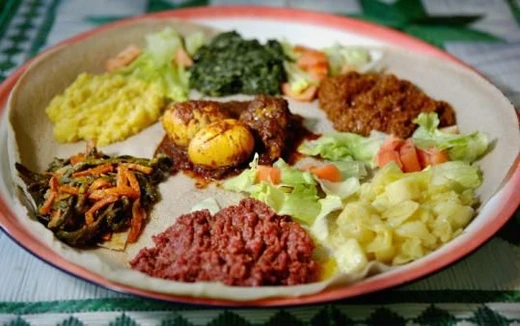
Mesob
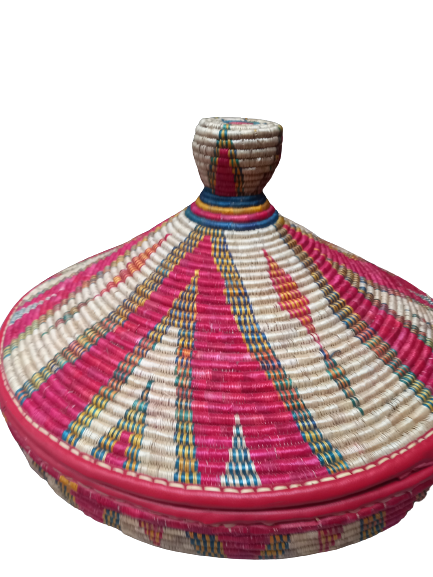
Harari basket for injera, a cultural symbol of Ethiopia.
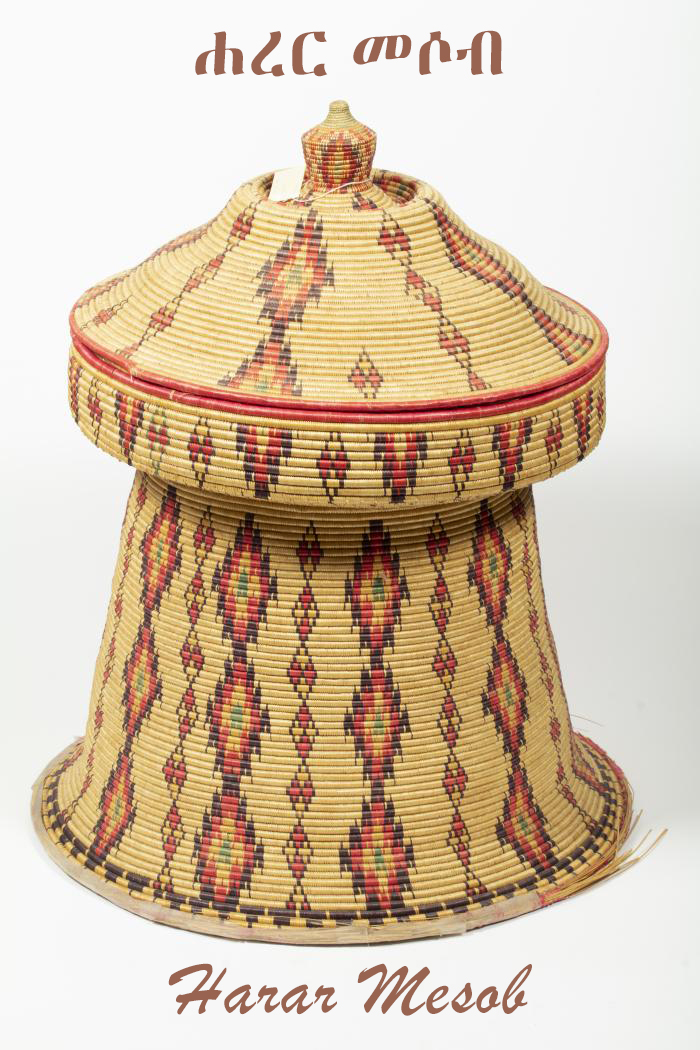
The mesob, also called the Harar mesob, is a basket from the Harari tradition, designed to hold injera, the flatbread common to Ethiopian and Eritrean cuisine. Woven from strong, durable local grasses and palm leaves that are partially dyed, it has become a widely recognized cultural emblem of Ethiopia.
Evidence of a basket resembling the mesob appears in Abyssinia as early as the sixteenth century, noted by the Portuguese explorer Francisco Álvares. However, the most famous version originates from Harar. In the mid-1970s, Amhara communities began hiring Harari weavers to create a hybrid style blending Abyssinian and Harari patterns, which eventually became the dominant form of mesob production in Ethiopia.
Though often labeled simply as Ethiopian, the mesob is part of a broader Harari basketry tradition. It appears on the 10 birr banknote and plays a role in funeral rites, where the baskets are given to support the deceased’s family. The mesob is widely viewed as a symbolic representation of Ethiopian and Eritrean culture and cuisine. The Harar mesob is especially prized for its complex and intricate designs. Today, authentic old Harari mesobs are rare, as most production has shifted to simpler, lower-quality Ethiopian versions.
- field
- Basketry / Cultural artifact
- known_for
- Storing injera; cultural symbol of Ethiopia and Eritrea
- origin
- Harar, Ethiopia
- material
- Locally grown and partially dyed grass and palm leaves
Lore & Background
A certain form of mesob was identified in Abyssinia as early as the sixteenth century, as reported by Portuguese explorer Francisco Álvares. However, the most prominent mesob is of Harar origin. In the mid-1970s, Amharas began recruiting Harari artisans to develop a particular mesob which incorporated Abyssinian and Harari designs; this variety came to dominate mesob production in Ethiopia.
Reader's Guide
The mesob basket belongs to a larger tradition of Harari basketry, though it is generally described as Ethiopian. It is depicted on the 10 birr note and used in funeral ceremonies to support the family of the deceased. The baskets are widely viewed as a symbolical representation of Ethiopian and Eritrean culture and their cuisine. The Harar mesob is known to be a quality mesob with very complex and prized designs. Today, it is very rare to find old original Harari mesobs, because people are making more simplified and lower quality Ethiopian models. The mesob's significance lies in its role as a durable, culturally emblematic container for injera, linking daily life, ceremony, and national identity across Ethiopia and Eritrea.
Did You Know?
- A mesob is depicted on the 10 birr note.
- The most prominent mesob is of Harar origin.
- In the mid-1970s, Amharas recruited Harari artisans to develop a mesob combining Abyssinian and Harari designs.
- Old original Harari mesobs are very rare today due to simplified, lower quality Ethiopian models.
Cultural Identity & Symbolism
The mesob occupies a singular place in the visual and ceremonial vocabulary of the Horn of Africa. Though it is commonly labeled as Ethiopian, the basket actually belongs to a broader Harari basketry tradition that predates modern national borders. Its status as a national emblem is so entrenched that it appears on the face of the 10 birr banknote, making it one of the few handcrafted objects to achieve that level of monetary representation. Beyond currency, the mesob plays a meaningful role in funerary rites, where it is employed to support the bereaved family, lending the ritual a tangible, communal dimension. Collectively, these associations have cemented the basket as a shorthand for Ethiopian and Eritrean identity and their shared culinary heritage. For many outside the region, a woven mesob is the first image that comes to mind when thinking of the country, functioning almost like a flag rendered in grass and palm fiber.
Origins & Historical Development
The earliest documented sighting of a mesob-like vessel dates to the sixteenth century, when the Portuguese explorer Francisco Álvares recorded its presence in Abyssinia. However, the form most people associate with the name today is distinctly Harari in origin, rooted in the weaving traditions of the ancient walled city of Harar. A pivotal shift occurred in the mid-1970s, when Amhara producers began actively recruiting skilled Harari weavers to create a hybrid mesob that fused Abyssinian motifs with Harari structural techniques. This blended variety quickly came to dominate basket production across Ethiopia, effectively reshaping what the national market recognized as the mesob. The episode illustrates how a regional craft could be absorbed into a broader national identity, with the Harari artisans' expertise becoming the invisible backbone of what was increasingly marketed as a pan-Ethiopian product.
Craftsmanship & Materials
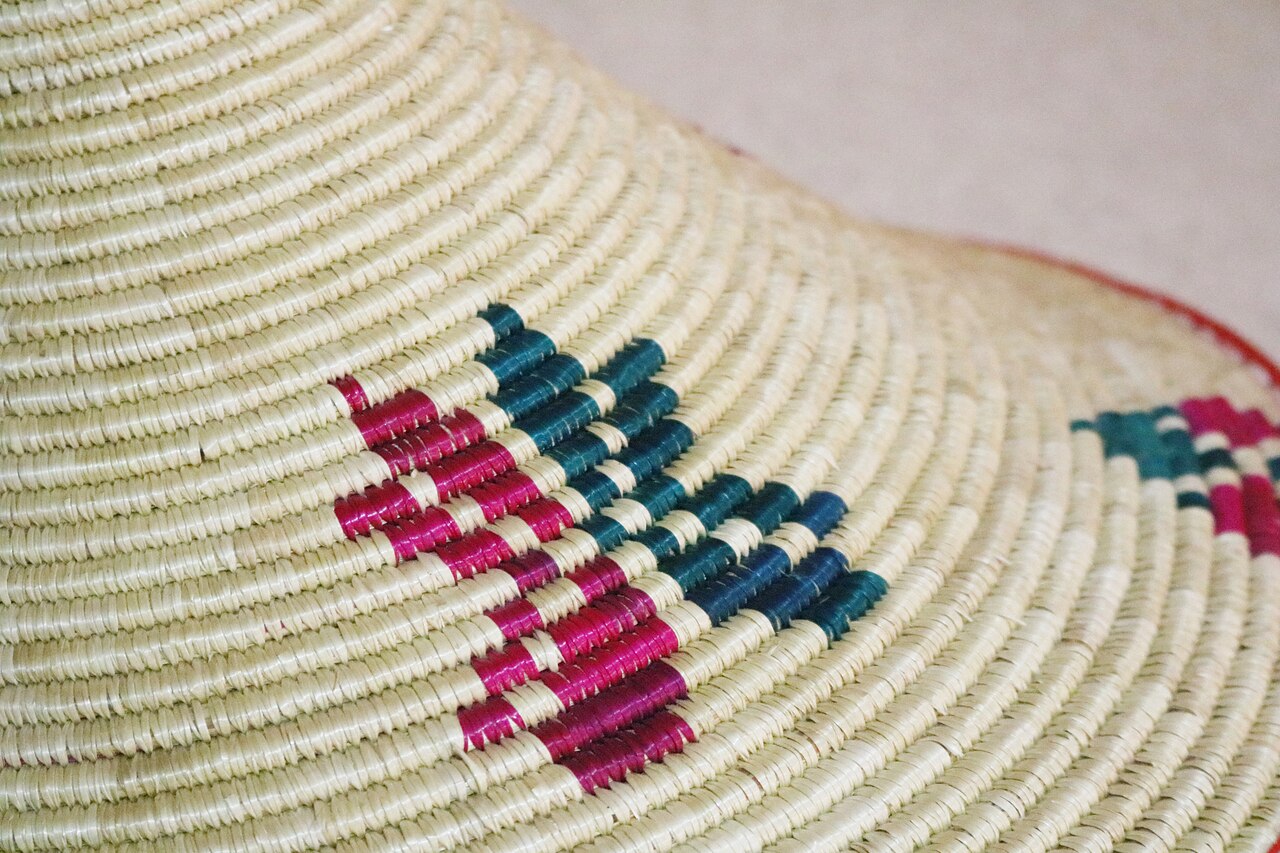
A mesob is constructed from locally cultivated grasses and palm leaves, materials chosen specifically for their tensile strength and long-lasting durability. The fibers are partially dyed to produce the rich color patterns that distinguish one basket from another, and the weaving technique demands considerable skill to maintain both structural integrity and aesthetic complexity. The Harar mesob, in particular, is celebrated for its extraordinarily intricate designs, which set it apart as a premium example within the wider family of Ethiopian and Eritrean baskets. Because the raw materials are grown locally, each basket carries a subtle connection to the specific soil and climate of its origin. The combination of natural fiber, hand-dyeing, and generations of refined weaving patterns makes the mesob not merely a storage vessel for injera but a small work of functional art, one whose quality has long been judged by the density and regularity of its weave and the boldness of its geometric motifs.
Legacy & the Erosion of Traditional Craft
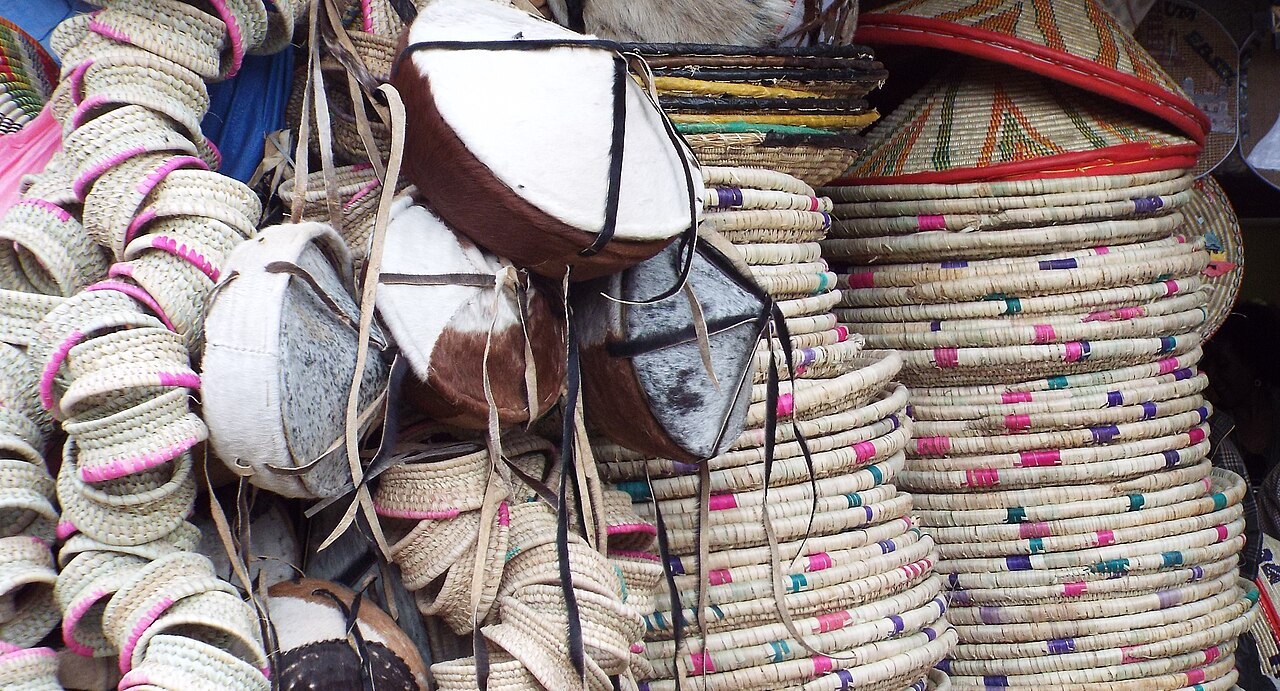
Despite its celebrated status, the original Harari mesob is becoming increasingly difficult to find. The mid-1970s fusion that brought Harari designs into mainstream Ethiopian production also set in motion a gradual simplification of the craft. Today, the baskets most commonly encountered are streamlined, lower-quality Ethiopian models that sacrifice the complex patterning and structural refinement that once defined the Harari tradition. This shift reflects a broader tension between mass-market demand and artisanal preservation: as consumer expectations favor speed and affordability, the time-intensive techniques that produce a true Harar mesob struggle to remain economically viable. The result is a cultural paradox in which the very object that symbolizes national identity is, in its most authentic form, growing rarer. Collectors and cultural advocates now regard surviving old Harari mesobs as precious artifacts, their scarcity a quiet reminder that a tradition can be universally recognized yet locally endangered.
Gallery
Frequently Asked Questions
What exactly is a Mesob?
The mesob is a traditional woven basket used to hold and serve injera, the spongy flatbread that forms the base of most Eritrean and Ethiopian meals. It functions as both a practical serving vessel and a decorative centerpiece on the dining table.
What materials go into making a Mesob?
Weavers work with locally harvested grasses and palm fronds, often applying partial dye to create the characteristic patterned look. The fibers are selected for their tensile strength so the basket can support the weight of stacked injera without warping.
Where did the Mesob originate?
The design traces back to the city of Harar, where a distinct weaving tradition developed over centuries. While similar baskets existed across the Horn of Africa, the Harari version became the most widely recognized and imitated form.
How far back does the Mesob tradition go?
A Portuguese traveler documented a basket very similar to the modern mesob in the sixteenth century, showing the craft was already well established by then. The style continued evolving through the 1970s, when weavers began blending Harari techniques with preferences from neighboring Amhara communities.
Why is the Mesob considered a cultural symbol?
Beyond its kitchen utility, the woven basket has come to represent the shared food heritage of Ethiopia and Eritrea in the same way a flag might. Its recognizable shape and colorful weave make it an instantly identifiable marker of the region's culinary identity.
More in Eritrean cuisine 1-24
Spotted an error? Know more?
This is a living reference — every entry is fact-audited, and reader corrections feed straight into our audit queue. Suggest an edit · See this site's audit record